
For \(n\) observations on a \((p-1)\) sphere in \(\mathbf{R}^p\), a finite mixture model is fitted whose components are spherical Laplace distributions via the following model $$f(x; \left\lbrace w_k, \mu_k, \sigma_k \right\rbrace_{k=1}^K) = \sum_{k=1}^K w_k SL(x; \mu_k, \sigma_k)$$ with parameters \(w_k\)'s for component weights, \(\mu_k\)'s for component locations, and \(\sigma_k\)'s for component scales.
Arguments
- data
data vectors in form of either an \((n\times p)\) matrix or a length-\(n\) list. See
wrap.spherefor descriptions on supported input types.- k
the number of clusters (default: 2).
- same.sigma
a logical;
TRUEto use same scale parameter across all components, orFALSEotherwise.- variants
type of the class assignment methods, one of
"soft","hard", and"stochastic".- ...
extra parameters including
- maxiter
the maximum number of iterations (default: 50).
- eps
stopping criterion for the EM algorithm (default: 1e-6).
- printer
a logical;
TRUEto show history of the algorithm,FALSEotherwise.
- object
a fitted
moSLmodel from themoSLfunction.- newdata
data vectors in form of either an \((m\times p)\) matrix or a length-\(m\) list. See
wrap.spherefor descriptions on supported input types.
Value
a named list of S3 class riemmix containing
- cluster
a length-\(n\) vector of class labels (from \(1:k\)).
- loglkd
log likelihood of the fitted model.
- criteria
a vector of information criteria.
- parameters
a list containing
proportion,location, andscale. See the section for more details.- membership
an \((n\times k)\) row-stochastic matrix of membership.
Parameters of the fitted model
A fitted model is characterized by three parameters. For \(k\)-mixture model on a \((p-1)\)
sphere in \(\mathbf{R}^p\), (1) proportion is a length-\(k\) vector of component weight
that sums to 1, (2) location is an \((k\times p)\) matrix whose rows are per-cluster locations, and
(3) concentration is a length-\(k\) vector of scale parameters for each component.
Note on S3 methods
There are three S3 methods; loglkd, label, and density. Given a random sample of
size \(m\) as newdata, (1) loglkd returns a scalar value of the computed log-likelihood,
(2) label returns a length-\(m\) vector of cluster assignments, and (3) density
evaluates densities of every observation according ot the model fit.
Validation status
This retained legacy interface is experimental. Its full numerical and
statistical contract has not been independently verified across supported
inputs. See riem-method-contracts and the installed contract
table for method-specific assumptions, restrictions, and evidence scope.
Examples
# \donttest{
# ---------------------------------------------------- #
# FITTING THE MODEL
# ---------------------------------------------------- #
# Load the 'city' data and wrap as 'riemobj'
data(cities)
locations = cities$cartesian
embed2 = array(0,c(60,2))
for (i in 1:60){
embed2[i,] = sphere.xyz2geo(locations[i,])
}
# Fit the model with different numbers of clusters
k2 = moSL(locations, k=2)
k3 = moSL(locations, k=3)
k4 = moSL(locations, k=4)
# Visualize
opar <- par(no.readonly=TRUE)
par(mfrow=c(1,3))
plot(embed2, col=k2$cluster, pch=19, main="K=2")
plot(embed2, col=k3$cluster, pch=19, main="K=3")
plot(embed2, col=k4$cluster, pch=19, main="K=4")
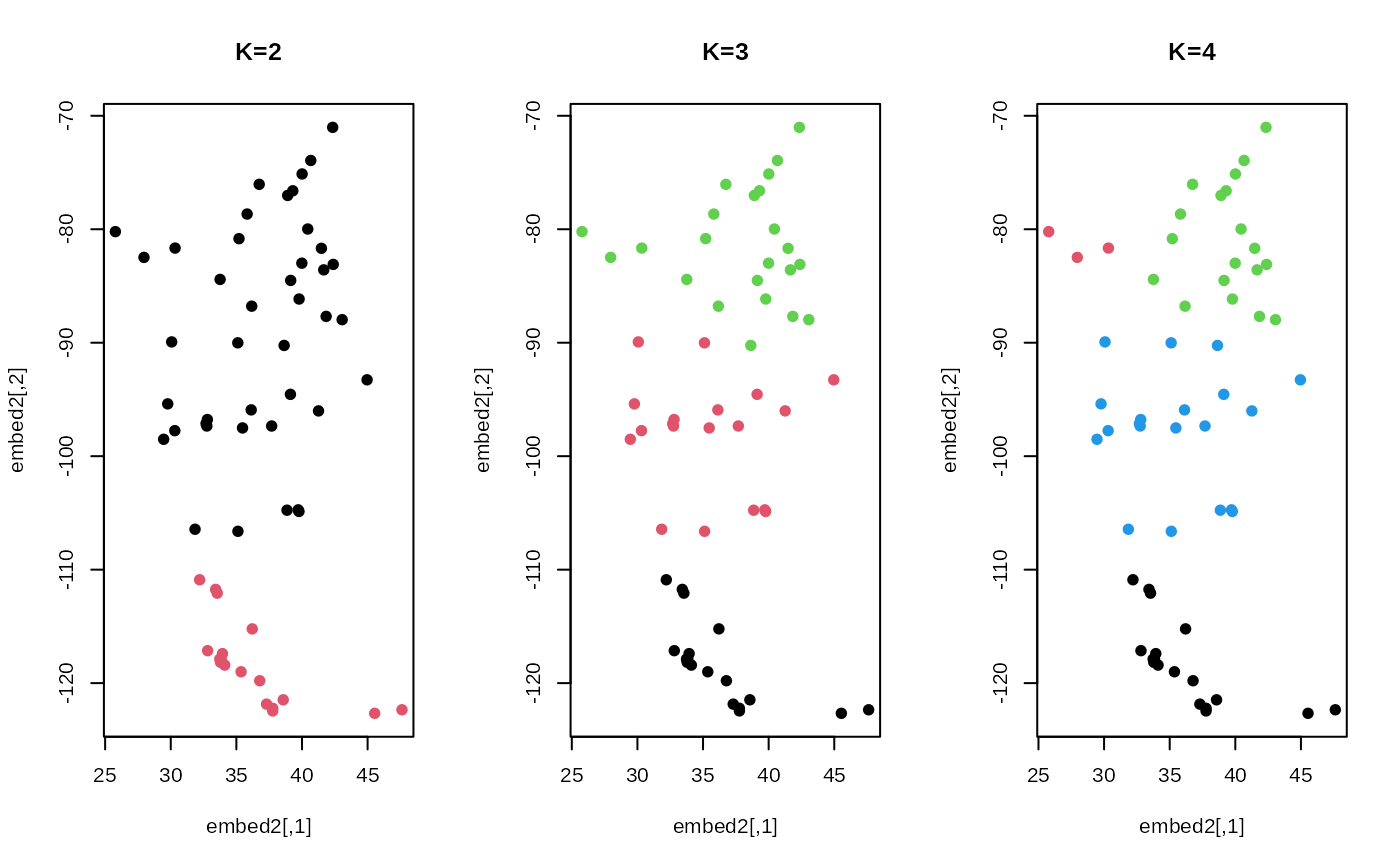 par(opar)
# ---------------------------------------------------- #
# USE S3 METHODS
# ---------------------------------------------------- #
# Use the same 'locations' data as new data
# (1) log-likelihood
newloglkd = round(loglkd(k3, locations), 5)
fitloglkd = round(k3$loglkd, 5)
print(paste0("Log-likelihood for K=3 fitted : ", fitloglkd))
#> [1] "Log-likelihood for K=3 fitted : 89.23077"
print(paste0("Log-likelihood for K=3 predicted : ", newloglkd))
#> [1] "Log-likelihood for K=3 predicted : 89.23077"
# (2) label
newlabel = label(k3, locations)
# (3) density
newdensity = density(k3, locations)
# }